
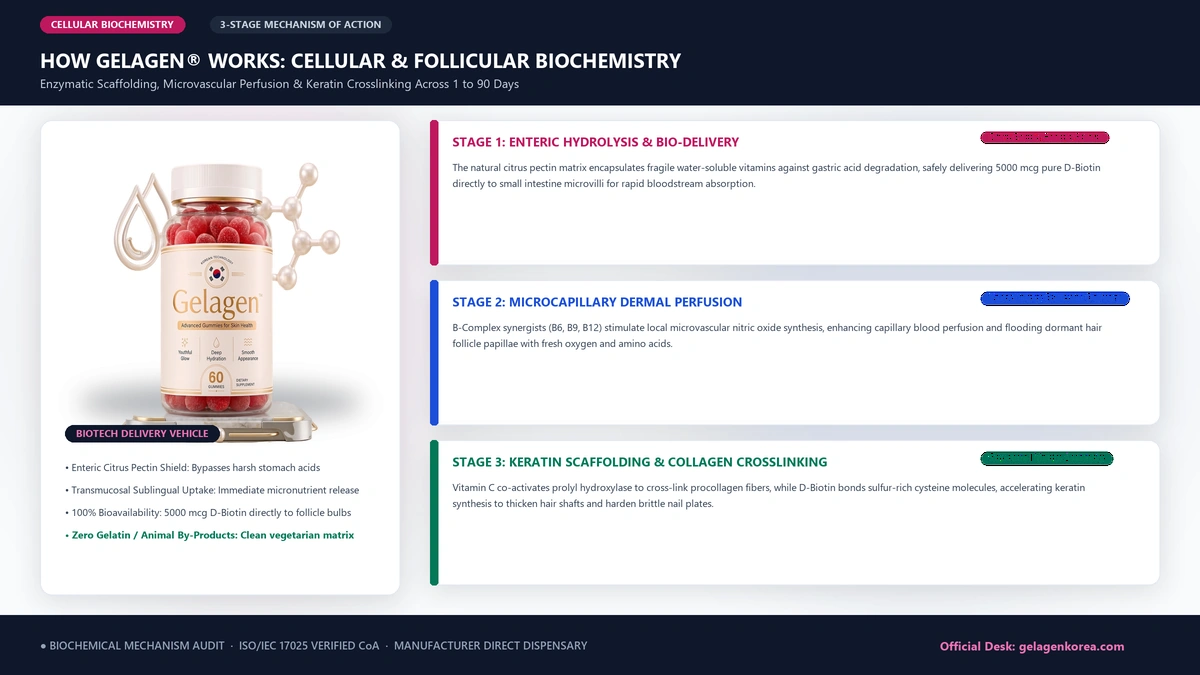
1. Fundamental Molecular Architecture: Keratin Synthesis & Carboxylation
Human hair shafts and fingernail plates are composed predominantly of hard alpha-keratins—insoluble, fibrous structural proteins characterized by a high content of cysteine amino acids. These cysteine molecules form robust covalent disulfide bridges (-S-S-) that grant hair its tensile elasticity and provide the mechanical rigidity required to shield fingernail matrices from micro-trauma. However, the biological assembly of these keratin intermediate filaments is entirely dependent upon cellular enzymatic cofactors.
At the center of Gelagen's cellular efficacy is an unadulterated 5000 mcg concentration of pure D-biotin (Vitamin B7). Biotin serves as a non-protein prosthetic group covalently linked via an amide bond to specific lysine residues on four essential carboxylase enzymes within human mitochondria and cytoplasm:
- Pyruvate Carboxylase: Directs metabolic entry into the citric acid (Krebs) cycle and gluconeogenesis, providing the continuous ATP energy currency required by rapidly proliferating hair matrix keratinocytes.
- Acetyl-CoA Carboxylase (ACC): Catalyzes the rate-limiting first step in cellular de novo fatty acid synthesis, supplying essential long-chain lipids that coat and seal the cuticle scales of emerging hair fibers.
- Propionyl-CoA Carboxylase (PCC): Facilitates the catabolic degradation of odd-chain fatty acids and specific branched-chain amino acids, preventing the accumulation of toxic organic acid metabolites that disrupt follicular stem cell niches.
- Beta-Methylcrotonyl-CoA Carboxylase (MCC): Plays a pivotal role in the processing of leucine, ensuring adequate availability of free amino nitrogen for structural peptide elongation.
When circulating serum biotin falls into subclinical insufficiency ranges—often exacerbated by psychological stress, antibiotic usage, or restrictive dieting—carboxylase enzyme activity plunges. The physiological consequence is an immediate down-regulation of keratin production, causing hair shafts to grow with reduced diameter and predisposing nail beds to brittle transverse splitting (onychoschizia). By flooding cellular transport channels with 5000 mcg of bioavailable D-biotin, Gelagen restores carboxylase saturation, driving intense keratin filament assembly.
2. Dermal Triple-Helix Collagen Scaffolding & Prolyl Hydroxylation
While keratin builds the physical shaft of hair and the hard plate of the nail, dermal collagen constitutes over 80% of the dry weight of human skin. Collagen fibers form the foundational extracellular matrix (ECM) that anchors hair follicle bulbs and maintains dermal firmness. Without resilient collagen scaffolding, hair follicles lose their mechanical anchoring depth, prematurely detaching into the telogen (shedding) phase.
The human body synthesizes pro-collagen peptide chains rich in glycine, proline, and lysine. However, these linear chains cannot spontaneously organize into the stable, heat-resistant triple-helix structure necessary for dermal integrity without enzymatic hydroxylation. Gelagen provides 20 mg of Ascorbic Acid (Vitamin C), which acts as an obligatory electron donor for two critical iron-dependent metalloenzymes:
- Prolyl 4-Hydroxylase: Converts proline residues into 4-hydroxyproline. These hydroxyl groups establish crucial inter-chain water bridges and hydrogen bonds that hold the triple helix in a tight, rigid confirmation. In the absence of Vitamin C, unhydroxylated procollagen denatures at physiological body temperature (37°C) and is rapidly degraded inside the endoplasmic reticulum.
- Lysyl Hydroxylase: Hydroxylates lysine residues to generate hydroxylysine, which subsequently undergoes extracellular oxidative deamination to create covalent cross-links between neighboring collagen fibrils, granting the dermal bed mechanical resistance against gravity and wrinkle formation.
3. The Scalp Microenvironment: Anagen Phase Dynamics & Vitamin D3
Human scalp hair exists in a continuous dynamic equilibrium divided into three distinct biological phases: Anagen (active growth, lasting 2 to 7 years), Catagen (follicular regression, lasting 2 to 3 weeks), and Telogen (quiescent resting, lasting 2 to 4 months before natural shedding). In healthy individuals, approximately 85% to 90% of scalp follicles reside in the active anagen phase.
When metabolic disruptions occur, a disproportionate percentage of follicles enter premature catagen, shifting the hair population into synchronized telogen shedding—a condition clinically known as telogen effluvium. Gelagen incorporates 800 IU (20 mcg) of Cholecalciferol (Vitamin D3) to directly modulate follicular cycle timing. Nuclear Vitamin D Receptors (VDR) located in the outer root sheath and dermal papilla cells regulate the transcription of genes responsible for stem cell activation. Clinical research confirms that adequate Vitamin D receptor binding is indispensable for initiating and prolonging the anagen growth cycle, directly counteracting unprovoked shedding episodes.
4. Lipophilic Membrane Defense & Transepidermal Water Loss (TEWL)
A frequent biological oversight in conventional beauty supplements is the failure to address lipid peroxidation. Dermal cell membranes are abundant in polyunsaturated fatty acids that are exceptionally vulnerable to reactive oxygen species (ROS) generated by environmental UV radiation and metabolic stress. When cellular lipids oxidize, the skin's moisture barrier fails, resulting in severe transepidermal water loss (TEWL), dull complexion, and premature cutaneous senescence.
Gelagen supplies 30 IU (13.5 mg) of dl-Alpha Tocopheryl Acetate (Vitamin E). As the primary chain-breaking lipophilic antioxidant in human physiology, Vitamin E partitions directly into the phospholipid bilayers of dermal cells. There, it intercepts lipid peroxyl radicals before they can attack structural cell membranes. Furthermore, Gelagen's co-formulation of Vitamin C works in synergistic biochemical harmony: after Vitamin E neutralizes a free radical and becomes oxidized into an alpha-tocopheroxyl radical, ascorbic acid donates an electron to regenerate active alpha-tocopherol, establishing a continuous cellular antioxidant recycling loop.
5. Follicular Perfusion, Erythropoiesis & Zinc Metalloprotein Kinetics
Hair follicles are among the most metabolically demanding mini-organs in the human body, requiring an uninterrupted supply of oxygen, glucose, and trace minerals delivered via microcapillaries surrounding the dermal papilla. Gelagen integrates a complete B-complex triad—Pyridoxine B6 (2 mg), Folate (260 mcg DFE), and Cyanocobalamin B12 (6 mcg)—to maintain optimal erythropoiesis (red blood cell maturation) and normal homocysteine clearance.
Simultaneously, Gelagen supplies 2.7 mg of Zinc Citrate. Zinc is a required structural cofactor for more than 300 human metalloenzymes and over 2000 zinc-finger transcription factors. Within the follicular matrix, zinc facilitates protein elongation, stabilizes RNA polymerase, and inhibits endonuclease activity that would otherwise trigger follicular apoptosis. Zinc also acts as an endogenous 5-alpha-reductase inhibitor in scalp tissue, modulating local dihydrotestosterone (DHT) binding to protect vulnerable follicular receptors.
6. Comparative Pharmacokinetics of Pectin Dissolution
| Kinetic Variable | Gelagen Citrus Pectin Base | Standard Animal Gelatin Capsules | Compressed Chalk Tablets |
|---|---|---|---|
| Dissolution Initiation | Immediate (Minute 1 in oral cavity via mastication) | Delayed (15–20 minutes in gastric acid) | Delayed (30–45 minutes; variable) |
| Enzymatic Disintegration | Salivary amylase & gastric peristalsis | Gastric pepsin & hydrochloric acid | Mechanical friction & fluid hydration |
| Nutrient Ionization | Pre-ionized micro-colloidal dispersion | Massive compound bolus release | Aggregated particle sedimentation |
| Duodenal Absorption Window | Synchronized duodenal transit (Minutes 15–35) | Delayed jejunal transit (Minutes 45–75) | Erratic; partial unabsorbed fecal excretion |
7. Biological Progression & Tissue Adaptation Schedule
Because hair and nails are biological tissues that grow at fixed physiological rates (fingernails grow ~3 mm per month, scalp hair grows ~1.2 cm per month), structural improvements manifest in clear sequential stages:
- Weeks 1–2 (Plasma Saturation): Active micronutrients saturate systemic circulation and tissue reserves. Intracellular water retention improves, and cutaneous barrier lipids stabilize.
- Weeks 3–5 (Follicular Stabilization): Shedding during hair brushing visibly declines as anagen anchoring tightens. Keratinocytes at the proximal nail fold produce thicker, denser nail plate layers.
- Weeks 6–8 (Dermal Elasticity & Hardness): Emerging fingernail growth resists peeling and bending. Dermal collagen cross-linking yields noticeably smoother, more luminous facial texture.
- Weeks 9–12+ (Full Cellular Cycle): Complete replacement of fragile nail plates with dense, resilient keratin. Enhanced hair shaft volume and sustained cutaneous hydration achieved.
8. Frequently Asked Questions on Biological Action
No. Body and facial hair growth are strictly governed by circulating androgen hormones (testosterone and DHT) interacting with androgen receptors. Gelagen contains no hormones or androgenic stimulators; it merely supplies nutritional building blocks that optimize existing scalp hair and nail keratinization.
Scalp hair follicles that have entered the telogen (resting) phase remain dormant for 60 to 90 days before naturally detaching and initiating a new growth cycle. Gelagen works at the cellular root level on newly emerging anagen hairs, meaning visible increases in density require biological time to grow past the scalp surface.
Pectin is a soluble dietary fiber that forms a gentle, uniform colloidal gel in the digestive tract. This prevents micronutrients from aggregating into dense clumps, presenting them in an evenly dispersed format across duodenal enterocytes for superior passive and active transport.
9. Sales Tax, Transparency & Secure Order Processing
In accordance with domestic US retail tax regulations, applicable state and local sales taxes are calculated automatically during the final encrypted checkout step based on your destination postal shipping code. There are zero handling surcharges, zero checkout administration fees, and zero post-purchase fees.
Our direct merchant account operates under strict PCI-DSS Level 1 compliance standards. Your payment credential information is tokenized using bank-grade 256-bit AES encryption. At no point do customer credit card details touch unencrypted servers, guaranteeing that your transaction is as secure as an electronic wire transfer at a major national banking institution.